
Whatever (Michel Houellebecq, 1994) Review
The programmed loneliness of a liberal society.
Early on certain individuals experience the frightening impossibility of living by themselves; basically they cannot bear to see their own life before them, to see it in its entirety without areas of shadow, without substance. Their existence is I admit an exception to the laws of nature, not only because this fracture of basic maladjustment is produced outside of any genetic finality but also by dint of the excessive lucidity it presupposes, an obviously transcendent lucidity in relation to the perceptual schemas of ordinary existence. It is sometimes enough to place another individual before them, providing he is taken to be as pure, as transparent as they are themselves, for this insupportable fracture to resolve itself as a luminous, tense and permanent aspiration towards the absolutely inaccessible. Thus, while day after day a mirror only returns the same desperate image, two parallel mirrors elaborate and edify a clear and dense system which draws the human eye into an infinite, unbounded trajectory, infinite in its geometrical purity, beyond all suffering and beyond the world.
On a typical day in the now-distant year of 1994, a 38-year-old Frenchman published a novel about what we now call an “incel”. The author probably never imagined that, a few years later, the archetype he portrayed with such detachment and apathy would evolve into a concrete concept with which many people in today’s society would unwillingly identify.
Whatever is, in essence, a critical X-ray of contemporary society. Unlike Bukowski, who delivers his critique through society’s scourges, Houellebecq offers his commentary through the first-person account of a nameless 30-year-old IT engineer who, despite holding a respectable social position, feels increasingly stifled by a profound emotional void. Incapable of communicating anything beyond the surface level, the engineer depicts the world around him with stark, sterile rawness. He is the embodiment of a modern antihero: passive, misogynistic, contemptuous, and unable to form human connections. Fundamentally, he is a man unmoored by modernity, drifting without ideologies, faith, or direction.
I’ve lived so little that I tend to imagine I’m not going to die; it seems improbable that human existence can be reduced to so little; one imagines, in spite of oneself, that sooner or later something is bound to happen. A big mistake. A life can just as well be both empty and short. The days slip by indifferently, leaving neither trace nor memory; and then all of a sudden they stop.
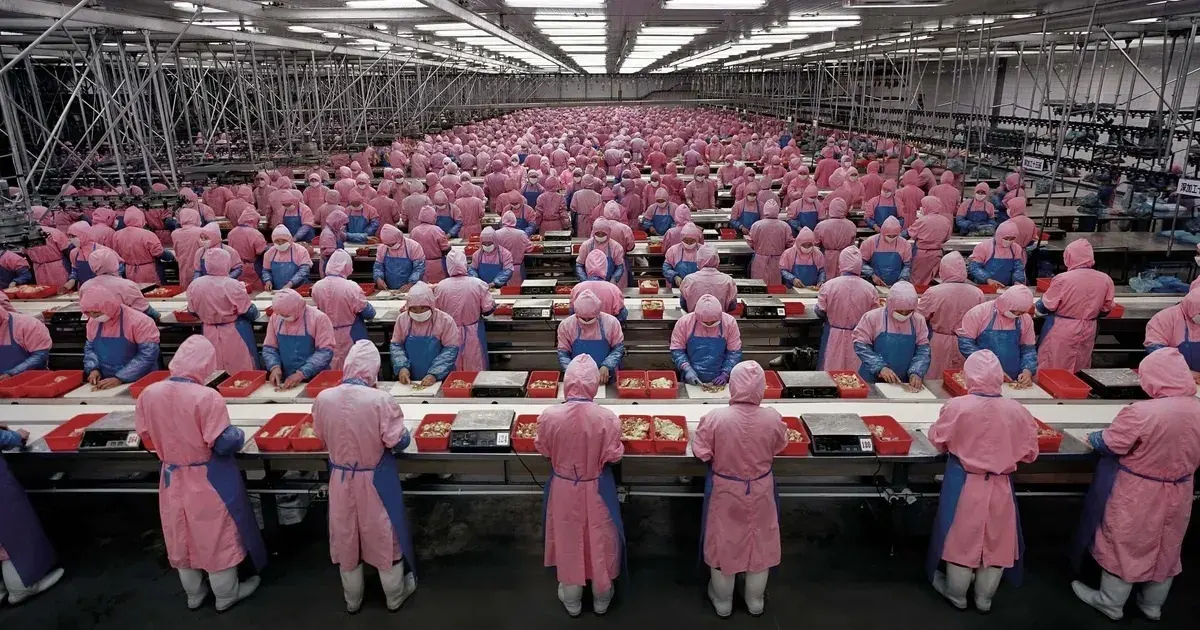
In the portrayal of the protagonist’s work environment, Houellebecq depicts office life as an empty and dehumanizing routine where individuals find neither meaning nor personal growth; it’s not a source of fulfillment, but rather, a source of emotional exhaustion—an idea that echoes Kafka’s perspective. At the same time, the French author astutely captures the modern, “cool” corporate culture that increasingly engulfs us. The more prestigious and productive the company becomes, the more aligned—and screwed over—the employee working under its rule must feel, creating a toxic relationship of dependency.1 In fact, the book revolves around this very tension, generated by different forces that result in the constant anhedonia experienced by the main character.
Next I notice that all these people seem satisfied with themselves and the world; it’s astonishing, even a little frightening. They quietly saunter around, this one displaying a quizzical smile, that one a moronic look. Some of the youngsters are dressed in leather jackets with slogans borrowed from the more primitive kind of hard rock; you can read phrases on their backs like Kill them all! or Fuck and destroy!; but all commune in the certainty of passing an agreeable afternoon devoted primarily to consumerism, and thus to contributing to the consolidation of their being.
Houellebecq’s narrative style is in tune with the protagonist’s situation, evoking the taste of the countless cigarettes he smokes to numb his existential void. His short, emotionally flat, and often vulgar sentences reflect the characters’ apathy and automatism, resulting in tedious, monotonous prose. The protagonist’s essayistic digressions interrupt the action to the point of becoming part of the narrative form, and making the work resemble an essay disguised as fiction. In this way, language becomes a means of conveying his daily sense of meaninglessness rather than beautifying it.
The plot is virtually nonexistent. It’s just a random fragment of a random person’s life, devoid of any identity due to the depersonalizing and dehumanizing effects of modern society, which seems to be a thesis in itself: modern life is a repetition lacking epic significance. It’s a subtle battlefield where individuals compete for economic and sexual capital. Those lacking “attractiveness” or “talent” are cast aside, while the ugly, the poor, and the socially awkward not only fail, but are also humiliated for it.
Economic liberalism is an extension of the domain of the struggle, its extension to all ages and all classes of society. Sexual liberalism is likewise an extension of the domain of the struggle, its extension to all ages and all classes of society.2
Thus, Houellebecq subverts the idea that freedom necessarily brings equality. According to him, sexual liberation has created a competitive marketplace where some gain access to pleasure while others are perpetual spectators. Therefore, the protagonist’s sexual frustration is a metaphor for social failure.
Applying this market logic to human relationships reveals another of the novel’s central themes: desire is not democratic. Unlike access to goods or services, which can be regulated, the object of desire—who desires whom, who is desired, and who is not—is shaped by invisible yet ruthless hierarchies. From the engineer’s perspective, eroticism becomes a privilege rather than a right. This exclusion affects not just the body, but also the subject’s entire sense of dignity. Through this lens, Houellebecq unveils a new form of inequality that is more intimate, less visible, and equally devastating.
I can’t say that I enjoyed Whatever. In fact, I don’t think it’s meant to be enjoyed; rather, it forces you to confront the discomfort of relating to certain aspects of a depressed character and to despise the vulgar treatment of sex and the objectification of women in a world where nothing truly matters. While it can be read as an exercise in cynicism, it can also be seen as a veiled critique. It’s not an apology for hatred; it’s a brutal portrayal of the conditions that produce it, for which Houellebecq offers no answers or comfort. Instead, he provides a cold, piercing diagnosis of contemporary existential emptiness, painting his nihilism less as surrender and more as a howl against a system that promises freedom while increasing loneliness.
At a more general level, we are all subject to ageing and to death. This notion of ageing and death is insupportable for the individual human being; in the kind of civilization we live in it develops in a sovereign and unconditional manner, it gradually occupies the whole field of consciousness, it allows nothing else to subsist. In this way, and little by little, knowledge of the world’s constraints is established. Desire itself disappears; only bitterness, jealousy and fear remain. Above all there remains bitterness; an immense and inconceivable bitterness. No civilization, no epoch has been capable of developing such a quantity of bitterness in its subjects. In that sense we are living through unprecedented times. If it was necessary to sum up the contemporary mental state in a word, that’s the one I’d undoubtedly choose: bitterness.
Footnotes
Footnotes
-
↩Long before the phrase became fashionable, my company developed an authentic enterprise culture (the creation of a logo, distribution of sweatshirts to the salaried staff, motivation seminars in Turkey). It’s a top-notch enterprise, enjoying an enviable reputation in its field; a good firm, whichever way you look at it. I can’t walk out just like that, you understand.
-
↩In societies like ours sex truly represents a second system of differentiation, completely independent of money; and as a system of differentiation it functions just as mercilessly. The effects of these two systems are, furthermore, strictly equivalent. Just like unrestrained economic liberalism, and for similar reasons, sexual liberalism produces phenomena of absolute pauperization. Some men make love every day; others five or six times in their life, or never. Some make love with dozens of women; others with none. It’s what’s known as “the law of the market”. In an economic system where unfair dismissal is prohibited, every person more or less manages to find their place. In a sexual system where adultery is prohibited, every person more or less manages to find their bed mate. In a totally liberal economic system certain people accumulate considerable fortunes; others stagnate in unemployment and misery. In a totally liberal sexual system certain people have a varied and exciting erotic life; others are reduced to masturbation and solitude. Economic liberalism is an extension of the domain of the struggle, its extension to all ages and all classes of society. Sexual liberalism is likewise an extension of the domain of the struggle, its extension to all ages and all classes of society.