
Demon's Souls (FromSoftware, 2009) Review
A modern iteration of the King's Field franchise.
Before starting this review, I’d like to first express my gratitude to RPCS3 for allowing the community to enjoy this game on PC at silky-smooth 60 fps and stunning 8k resolution scaling. Originally experienced on PS3, I returned to Boletaria via the emulator to savor this enhanced and exquisite experience on PC.
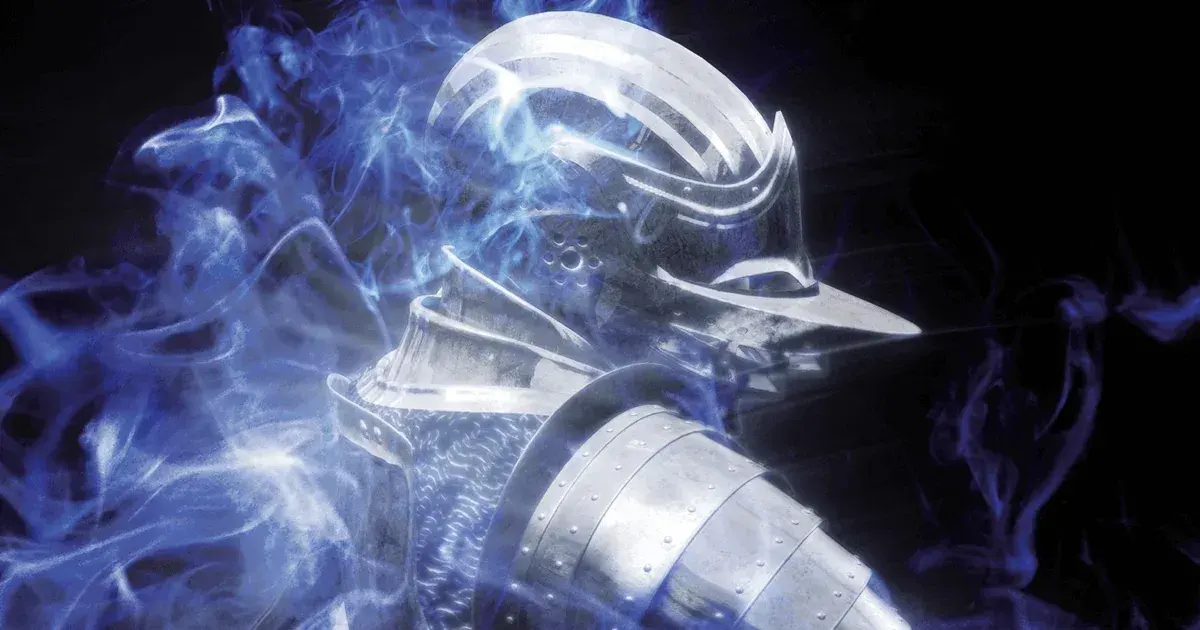
Before diving into Dark Souls II and Elden Ring to complete the Soulsborne series, I wanted to try Demon’s Souls first to see how the series had evolved. Even though the remake brought more attention to the title, the game was often overlooked not long ago, mainly because people viewed it as a prototype for Dark Souls I. Its poor marketing, the PS3 exclusivity, and lesser popularity compared to the aforementioned title also contributed to this perception, which only fueled my desire to play it.
Compared to the latest entries in the franchise, such as Dark Souls III or Elden Ring, the evolution is obvious. All the compartmentalized worlds and ancient art style of Demon’s Souls — reminiscent of a dusty tome filled with fantastical medieval tales from the gloomy kingdom of Boletaria — have morphed into complex, huge, linear worlds with richer content, and a more opulent art style without the characteristic blooming effect of Demon’s Souls.
From a gameplay standpoint, it’s easy to see the foundational elements that support the series. The naturalistic teaching of mechanics, the pervasive sense of solitude, and the challenging difficulty are the most patent common denominators, although I’ll discuss the latter in more detail later. Most of the stat attributes and weapon categories have also been carried over to newer releases, though Demon’s Souls offers fewer weapon varieties due to having less content compared to other Soulsborne games. Some other notable changes to the gameplay include the healing system, which replaced healing grasses with Estus Flasks (except for Bloodborne), and the combat system. While the one in Demon’s Souls may not be as polished as that of Bloodborne or Dark Souls III, which feel like refined iterations of it, it’s far from being as clunky as some claim. The controls are responsive, smooth, and fast, leading to satisfying and enjoyable gameplay. I was surprised to find backstabs and parries present, although the former can be hit-or-miss, sometimes failing to execute even when positioned correctly behind an enemy. I do miss the ability to kick, though.
However, there are rough edges that have been smoothed out in later installments, such as the useless Luck stat attribute and the equipment overload limit, which penalizes mobility when exceeding 50% of the limit, making heavy armor unappealing. It’s also annoying as it can prevent you from taking important loot. Thankfully, the penalty has been replaced in later entries by penalizing the player with slow walking instead.
Magic is ridiculously overpowered due to miracles like Second Chance or Regeneration, and spells like Warding or Firestorm, which make the game dramatically easier. No wonder most of these were left out of subsequent Soulsborne games, and Firestorm was significantly nerfed in Dark Souls I.
We can also see where some gimmicks from future games came from, such as the use of the Storm Ruler against Yhorm the Giant in Dark Souls III, which was taken directly from the Storm King boss fight in level 4-3. Similarly, the appearance of another Gargoyle mid-fight in Dark Souls I mirrors the spawning of a second Maneater in level 2-2. Invisible walls also make their debut in this game, though only in world 4. Additionally, the healing system in Bloodborne resembles the healing grass system from Demon’s Souls, as it relies on farmable items called Blood Vials, which heal based on 40% of your total health instead of a fixed amount of HP.
The game’s length is one of its strongest points. Although it’s the shortest Soulsborne, it doesn’t fall short in delivering a satisfying experience. Like Dark Souls III, it benefits from a straightforward yet clever design, with each world feeling like a standalone experience due to its unique setting and the overarching depressing atmosphere of Boletaria.
While having the Nexus — the main hub — as the only proper way to navigate the world may seem inconvenient, it aligns with the game’s design philosophy. Interconnecting all the worlds would violate the principle of modular and independent worlds that defines Demon’s Souls and sets it apart from the rest of the Soulsborne series. Although each world is linear in design, the essence of the title lies in its non-linearity. Players are not forced to complete them in an orderly fashion, as all worlds are available from the moment you enter the Nexus. Each one has its own set of enemies that drop a specific types of items: healing grass in Boletarian Palace, stones for upgrading equipment in Stonefang, spices in Latria, souls in the Shrine of Storms, and lotuses in the Valley of Defilement. These elements, combined with the freedom to choose the order of progression, allow players to develop their own strategies for overcoming the challenge, resulting in a unique experience for everyone.
Regarding the inevitable topic of difficulty, Demon’s Souls achieves its challenging nature as a byproduct of creating a rewarding experience, according to what Miyazaki says in this 2009 Gameinformer’s interview excerpt:
Having the game be “difficult” was never the goal. What we set out to do was strictly to provide a sense of accomplishment. We understood that “difficulty” is just one way to offer an intense sense of accomplishment through forming strategies, overcoming obstacles, and discovering new things. Our goal of a sense of accomplishment was the basis of the game since the early stages of development, and we never strayed from that.
Nevertheless, many people complained about the game’s difficulty upon its release. Atlus, Demon’s Souls publisher in North America, cleverly used this criticism in its minimal marketing campaign, promoting the game’s challenging nature as an attractive selling point for hardcore players.

Demon’s Souls commercial in 2009 1
As a seasoned player of the series, I resonate with the popular saying in the community that “the previous game is harder than the next”. I didn’t find Demon’s Souls particularly difficult, although it does have its peculiarities. The soul form is the most punishing in the series, limiting us to 50% health, which will most likely lead us to equip the Cling Ring to increase that percentage to 75%, thereby losing a valuable ring slot. Additionally, the soul form also affects the world tendency, an intriguing mechanic in theory but a total mess in practice, especially since it also depends on online play.
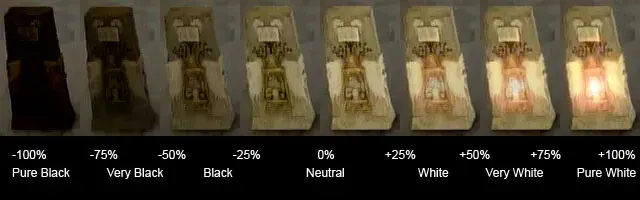
World tendency 2
I played both a quality build on my PS3 playthrough and a magic build on my RPCS3 run. As I’ve already mentioned, magic is overpowered in this entry, so the second playthrough was a breeze. Even so, I didn’t find my quality build playthrough particularly challenging, with King Allant and Maneater being the bosses that gave me the most trouble in both runs. However, it’s undeniable that the level design of Demon’s Souls contributes significantly to its difficulty. There are at most two or three Archstones per world and few shortcuts. For instance, 4-2 will haunt me for some time due to the headaches it gave me playing with the quality build, as there are no shortcuts to the boss. In a similar vein, 5-2 is memorable for the long trek required to reach the shortcut.
The fact that the only ambient tune on the soundtrack is one of the best ambient tracks that I’ve ever heard still puzzles me. Aside from the cinematic intro, this is the first track that we hear not only in the game but in the entire Soulsborne series. In some ways, it’s the antithesis of the whole experience, evoking peace and relaxation while converging with the common sense of mystery and fuzziness. It feels like being on the razor’s edge between life and death.
As for the overall soundtrack, it might be my favorite of the entire series. Unlike the higher-budget soundtracks of recent titles that often lean heavily on epic tones, Demon’s Souls focuses more on classical music rather than orchestral and choir compositions. This choice suits the atmosphere of Boletaria better and makes the soundtrack more inviting for daily listening.
Before coming to the conclusion, I’d like to point out that many people praise Miyazaki for supposedly being the mastermind behind the Soulsborne franchise, which is a half-truth because they blatantly forget that it wouldn’t be what we know today if it weren’t for Demon’s Souls producer Takeshi “Ken” Kajii. He was the one who came up with the idea of reviving the dark fantasy action game genre à la FromSoftware’s King’s Field franchise3 by iterating the concept under Miyazaki’s vision. In fact, he’s mentioned in the credits of Demon’s Souls (2020) for his contribution to the development of the original game.

Demon’s Souls is a solid game that stands well on its own, with a remarkable identity and arguably better in some aspects than its younger brothers, such as its captivating and unique atmosphere. However, it indeed feels like a foundational piece for what would come later. For instance, its combat system, while impressive, laid the groundwork that evolved into the refined mechanics seen in Dark Souls III, which I personally consider the pinnacle of the series due to its well-tuned combat, variety of weapons, tons of content that doesn’t feel like filler, hidden areas that reward exploration, and a world that, while linear, is densely packed. Looking ahead, I hope FromSoftware creates another Soulsborne game that blends the refined elements of Dark Souls III with the unparalleled atmosphere and compartmentalized worlds found in Demon’s Souls. Such a blend could truly elevate the series to new heights.
Nevertheless, Demon’s Souls remains a significant milestone in the video game industry, often overshadowed by Dark Souls I. It laid the foundation for what has become one of the most renowned video game franchises in recent memory, demonstrating how a project initially met with skepticism from executives could evolve through the conviction and passion of its developers. It pushed the boundaries of the medium one step further, breaking the mold of what was once thought to be unbreakable and serendipitously becoming a mainstream success, selling million of copies across the world.
As time progresses, it’s crucial that new visionary projects like Demon’s Souls continue to emerge, challenging established norms within the medium, offering fresh perspectives and innovative approaches to video games, thereby expanding our understanding and appreciation of what gaming can achieve.
There is no great genius without a mixture of madness.
Footnotes
Footnotes
-
Siliconera Staff (July 10, 2009). “Demon’s Souls Director Didn’t Think Demon’s Souls Was That Hard”. siliconera.com. ↩
-
Taken from giantbomb.com ↩
-
MTV Video Games (October 29, 2009). “‘Demon’s Souls’ Producer Talks Inspiration And Future Plans”. MTV. ↩