
Antichrist (Lars von Trier, 2009) Review
Dedicated to Andrei Tarkovsky.
Depression goes far beyond simply feeling sad or having a bad day. It is a persistent and pervasive condition that can feel like an overwhelming physical burden that one is unable to shake. Over time, it can become so heavy that it eventually drains your energy, consequently leaving you in a chronic state of apathy. Despite attempts to find solace in dopamine-boosting activities, you inevitably find yourself back on the same miserable path.
Antichrist represents the first installment of the unofficial “Depression Trilogy” by the controversial Danish filmmaker Lars von Trier, which is completed by Melancholia (2011) and Nymphomaniac (2013). He claimed that he took no pleasure from the creative process of Anthichrist1, as he was grappling with a profound depressive episode. During this challenging period, writing the screenplay became his sole source of motivation to get out of bed, serving as a form of therapeutic exercise.
The film’s prologue opens with an interesting concept executed in one of the most awful ways conceivable. An unnamed couple, credited as “She” (Charlotte Gainsbourg) and “He” (Willem Dafoe), is depicted engaging in explicit, unprotected sexual intercourse while their infant snoops them. Some subtle details, such as the baby monitor being on mute or the teddy bear tied to the balloon, may initially appear inconsequential. However, they assume greater significance later on, especially in the fourth chapter.
For some unfathomable reason, the child suddenly decides to jump out of a window just as the mother reaches her climax. What conceptually seems like a poetic juxtaposition of death and life left me laughing in disbelief at what I had just witnessed. I was unsure as to whether I was watching a parody of arthouse cinema or a perfume commercial, given the stylized presentation of the situation. It is shot in black and white, in slow motion, and set to Handel’s aria “Lascio Chi’o Pianga”. The entire scene begs to be described with a word that starts with “p” and ends with “ious”.
As a result, the nameless parents leave utterly devastated by the incident, which becomes the focal point of the narrative. Lars von Trier’s approach to coping with loss diverges from the conventional Kübler-Ross grief cycle, which comprises five stages: denial, anger, bargaining, depression and acceptance. The first three acts of the film represent stages of his own conceptualization, namely grief, pain, and despair. They are symbolized by three animals—a deer, a fox, and a crow—, collectively known as the Three Beggars, which also serves as the title of the fourth chapter, followed by the epilogue. Von Trier doesn’t posit an equivalent stage to acceptance, which is likely influenced by both his nihilistic view of life, as evidenced by his previous works, and his depressive state of mind at the time.
The initial chapter, titled “Grief”, serves to delineate the psychological profiles of the couple and their respective roles within the relationship. The characters in question are the only visible faces, along with Nick’s, which serves to underscore the fact that the plot is strictly focused on them. He is a therapist who is driven by rationality and appears to overcome the traumatic episode with remarkable speed. His detachment from the family, as stated by She, is accompanied by his exertion of complete control over the relationship, under the conviction that he is the optimal individual to treat his partner because of his deeper knowledge of her. This extends to advising her—or perhaps more accurately, forcing her—to refrain from taking her prescribed medication. His egocentrism and cynicism are evident in his disregard for the ethical boundary that therapists should not engage in sexual relationships with patients, even with consent, which is further compounded by the fact that therapists should not treat individuals with whom they have a personal relationship. In contrast, the character of She is depicted as the irrational party, as she is in such a state of grief that she inflicts self-harm and tries to desperately relieve her pain through sex. Despite their differences, they ultimately converge in a sense of failure, as illustrated by his lack of medical degree and her incomplete dissertation, called “Gynocide”.
In an effort to inhibit She’s fears, He inquires about her most significant dread, to which She replies “Eden”—their cabin in the woods. This response prompted me to frown in concern about the narrative’s trajectory, as it feels incongruous in light of the fate of her child. A response that alludes to death would have been a more appropriate fit, given the context.
He decides that the best way to demonstrate her irrational dread of Eden is to use a type of exposure therapy called flooding therapy. On paper, this seems like a reasonable approach, but the way He practices it is completely negligent. This psychotherapeutic method is conducted under controlled conditions and using psychologically proven relaxation techniques, which He successfully performs at the train. However, taking She directly to Eden right after her confession is completely reckless. In addition, most exposure therapy today gravitates toward the graded exposure technique, which relies on exposing the patient to a feared situation gradually, controlling the fear and the evolution of the patient at each step. But of course, this wouldn’t allow von Trier to perpetuate the chaos that takes place later and would necessitate a considerably longer timeframe to achieve a credible evolution, which wouldn’t fit in the conventional runtime of a film.
Upon arriving in Eden, He finds a deer (grief) with a dead fawn hanging from its uterus. Just as the deer cannot expel the lifeless fawn, the characters in the film—especially She—are unable to fully process or release their grief over the death of Nic. This event gives way to the second chapter, entitled “Pain”.
The plot, which initially appeared to delve insightfully into the psychological processes by which a couple grapples with the death of their child, ultimately prioritizes a senseless descent into a downward spiral of madness, violence, and sexual depravity, with the goal of eliciting shock and disgust in the viewer. What seemed to be an auspicious melding of the psychological exploration of Persona (Ingmar Bergman, 1966), the erotic drama of Eyes Wide Shut (Stanley Kubrick, 1999), and the influence of Japanese horror eventually manifested as yet another example of Lars von Trier’s proclivity for portraying extreme forms of depravity. However, unlike some of his other works, such as Dogville (2003), the portrayals lacked a compelling narrative that could provide a coherent foundation for them.
Notwithstanding the Christian allusions in the title and the symbolic portrayal of Adam and Eve in the and the Garden of Eden, a conclusive allegorical interpretation of the work remains elusive. Likewise, Antichrist throws a bunch of underdeveloped topics to construct an artificial scenario that reverses the conventional roles of “abuser” and “victim,” as typically attributed to men and women, respectively. Nevertheless, it is also possible to view He as the abusive figure, as He contributes to She’s mental instability by taking her to Eden. In any case, the primary vehicle for justifying this is conducted through “Gynocide”, a study of malevolent actions perpetrated against women throughout history. She concludes that her unfinished dissertation, based on the aforementioned topic, serves as a proof of the evil nature of women by following this logic: Nature is Satan’s Church. Human nature is evil. Women do not control their own bodies, nature does. Therefore, all women are inherently evil.
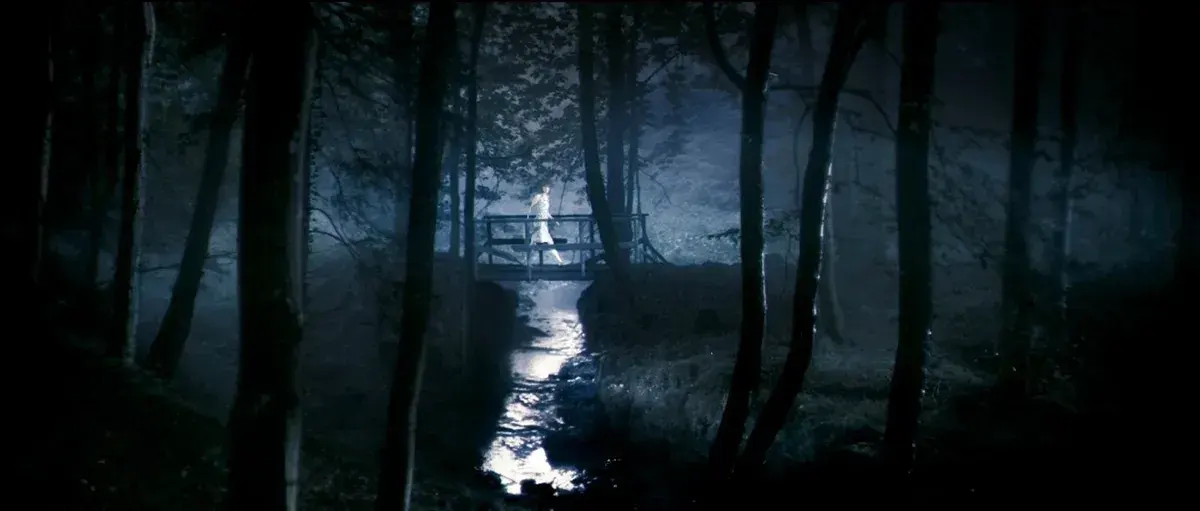
The second chapter concludes with He’s encounter with a disemboweled fox (pain), which proclaims, “Chaos reigns”. If I perceived the opening as p******ious, this scene is nothing short of an acute source of embarrassment and awkwardness, which persists as a dominant sentiment from this point onward due to the shallow and out-of-place dialogues that feel like a conversation between avant-teens attempting to demonstrate how deep they are.
In the third chapter, She’s neurotic conduct blows up. She discovers the autopsy report indicating that Nic’s feet were deformed, a finding that is corroborated by the Polaroid pictures that He reveals her, which clearly show Nic wearing his shoes reversed. This provokes an outburst of psychotic behavior in She that leads her to strike He’s penis. He is rendered unconscious by the impact, to the extent of remaining unaware of a metal rod piercing his leg. To ascertain whether such a state could be induced by a strong impact in that specific area of the body, I conducted further research to reaffirm my initial conclusion that it is essentially impossible (who would have thought?). Against all odds, I’m afraid this is another ridiculous and blatant stratagem of von Trier to manipulate the plot at his discretion. More so considering the disgusting subsequent scene, which displays ejaculation of blood. It is, indeed, essential for presenting a story of grief, pain, and despair, right?
She tries to keep He around by affixing a grindstone to his leg with the aforementioned rod, which might symbolize how deeply She wants to dominate him and control over the situation. If we were to read too deeply into the significance of the grindstone, it could be interpreted as a representation of the burden of masculinity and traditional male roles. However, through the power of cinematic magic, He partially succeeds in escaping by dragging with the heavy grindstone without tearing his leg to shreds. An impressive and unrealistic feat, no less. I use the word “partially” because She ends up finding him in a foxhole with a crow (despair). He attempts to kill the crow on numerous occasions, but it persists. While the scene made me laugh, the crow’s persistence might be indicative of the futility of attempting to eradicate or conceal despair and, in a broader sense, that nature cannot be fully controlled or destroyed. In fact, the confrontation with the crow and its unrelenting cawing leads her to find him, ultimately burying him alive and striking the earth vigorously to kill him.
The fourth chapter commences with She expressing remorse for her actions and subsequently exhuming He. To the surprise of no one, He is still alive. At the cabin, she quotes a fragment of the English poet Robert Herrick’s poem Upon Some Women: “False in legs, and false in thighs; / False in breast, teeth, hair, and eyes.”. She uses her physical charms to ensnare He, depicting her like a femme fatale. But her evilness is not only confined to transgressions against He, as it is disclosed that She committed infanticide. She saw Nic climbing up the table without intervening to prevent his demise, which is consistent with the apparent indications of parental negligence presented in the opening sequence. As an act of contrition, She cuts her clitoris off explicitly, a display that, in addition to evoking revulsion in the viewer, also represents the removal of pleasure as a form retribution for her sin.
Subsequently, He unexplainably notices the Three Beggars constellation—it is not a constellation at all—, which makes way for two of the Three Beggars to physically appear. In words of She, “When the Three Beggars arrive, someone must die”. For yet another inexplicable reason, He has the impulse to break a floorboard, beneath which is a gear and a crow—the missing Beggar. This is another scene that I define as “powered by the magic of cinema” and that made me shake my head in disbelief. However, in an attempt to find meaning, it strengthens what I mentioned about the scene in the foxhole. Moreover, the intrusion of a natural entity into a domestic space might symbolize how nature’s chaos is penetrating and disrupting the supposed order of human existence. Taking into account the brief mention to Sigmund Freud, we could associate what is beneath the floor as the hidden layers of the human psyche, where repressed feelings reside. Nevertheless, I believe that I am investing a greater degree of effort into imbuing the work with meaning than von Trier did in establishing a coherent and meaningful narrative structure with sophisticated symbolism.
While He endeavors to unscrew the metal rod, She attempts to kill him with scissors. This scene is an insult to the viewer’s intelligence because, when He has the chance to confiscate the sharp tool, He instead tosses it aside, thereby allowing her another chance to stab him. Surprisingly enough, when She has another opportunity to end his life, He manages to remove the metal rod, which doesn’t result in a severe hemorrhage. In fact, he is so recovered that he is able to stand up and strangle her. Let’s not forget that She still had the scissors in her possession and kindly waited for him to kill her. I’m grateful that She didn’t defend herself in order to put an end to this torture called Antichrist.
After strangling her, He sets her on fire in a pyre, a practice that bears resemblance to the witch burnings carried out by Christians during the late Middle Ages and early modern period, as addressed in the pictures of “Gynocide”. This representation reinforces the trope of the male protagonist as the heroic figure and the female character as the succubus.
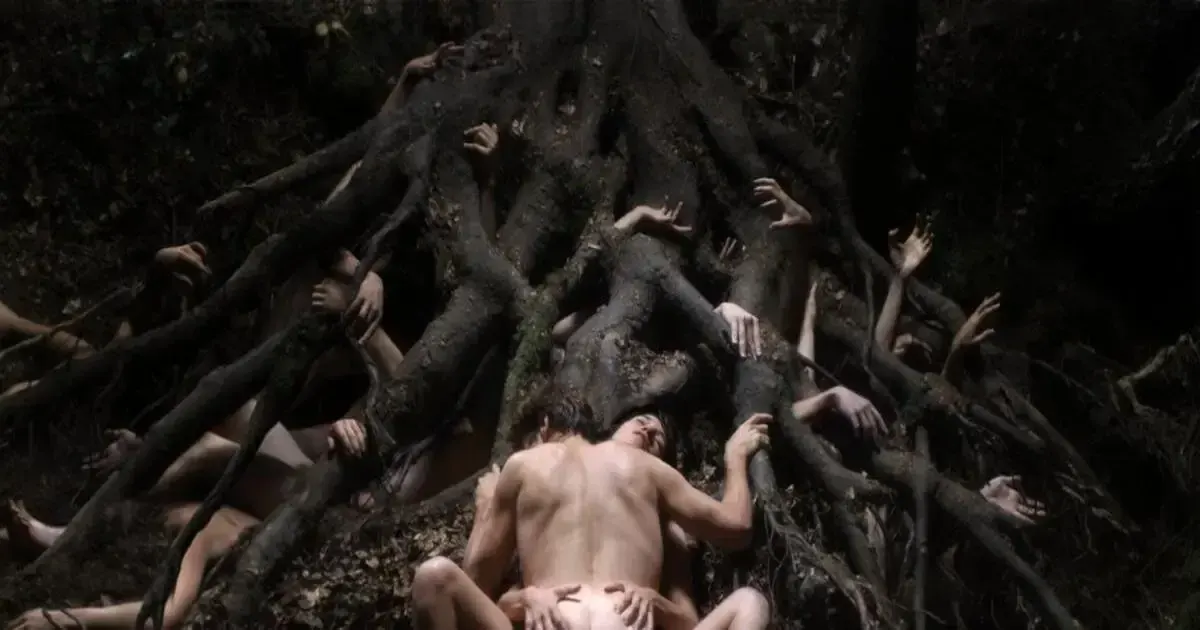
In the epilogue, He leaves the cabin and walks through the woods with a discernible limp. Just when the narrative seems to have reached its conclusion, the Three Beggars briefly reappear in the form of a vision, implying that someone’s death may be imminent. Shortly after they disappear, a large crowd of faceless women approaches He. It is possible that these women represent those killed by the same reasons as She. Although the epilogue is consistent with the brief and subtle implication of witchcraft at the end of the fourth chapter, it also serves to illustrate the narrative’s incoherence. What began as a story about coping with loss ultimately culminates in… What exactly? A meaningless spectacle of violence and sadistic horror? An unjustified display of compulsive sex? A friendly reminder not to be treated poorly by your significant other? Is it a glorious ode to men as bringers of peace, or a critique of men for driving women to madness? Is it a tribute to women murdered by men throughout history? Is it a critique of Christianity? Is it about witchcraft? Despite my attempts to make sense of this chaos, I don’t think von Trier had a clear vision for what he wanted to achieve with Antichrist, other than to display violence and sex.
As much as the Danish filmmaker did not enjoy making this film, I did not enjoy watching it either. It is a convoluted mess that goes nowhere. It is a mix of promising ideas that ultimately lead to a futile and excessive display of graphic content that seems more aimed at provoking a reaction from the audience than conveying a meaningful story about grief, pain, and despair. The apparent symbolism feels vapid and forced, and the gore is entirely superfluous to the plot. Without it, it is unlikely that Antichrist would have achieved the same level of recognition, as it offers little in terms of narrative substance.
It’s baffling to consider how Charlotte Gainsbourg and Willem Dafoe could have willingly taken part in such a film, given their respective statuses in the industry. This is especially true of Gainsbourg, whose remarkable performance in her demanding and even degrading role overshadows the film’s overall weakness.
I’m curious about what Andrei Tarkovsky, the Russian director to whom this film is dedicated, would have thought about Antichrist. However, von Trier could have benefited from studying the techniques of his idol to create a compelling story with substance using the cinematic language without succumbing to his impulse to provoke the public.
You shall not suffer a witch to live.
Footnotes
Footnotes
-
Sean O’Hagan (July 12, 2009). “Interview: Lars von Trier”. The Guardian. ↩