
28 Years Later (Danny Boyle, 2025) Review
The sequel that makes 28 Weeks Later look like a masterpiece.
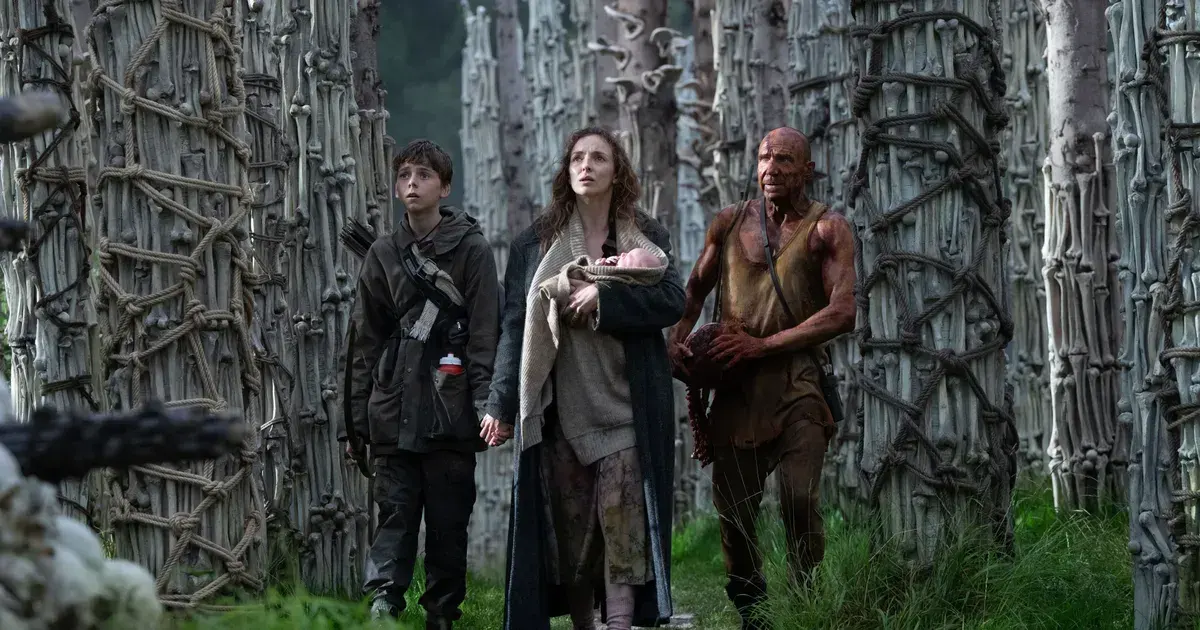
There are directors with a special fixation on a particular theme that they explore throughout their careers. In my recent Anora (2024) review, for example, I highlighted Sean Baker’s recurring tendency to portray women involved in the sex industry in his films. Conversely, there are directors like Danny Boyle who have explored diametrically opposite genres over the years. Who would guess that Trainspotting (1996), 28 Days Later (2002), and Slumdog Millionaire (2008) all came from the same mastermind?
Despite his extensive and prolific filmography, Danny Boyle is not a director known for making sequels. In fact, the only two he’s made—T2 Trainspotting (2017) and 28 Years Later—were released many years after their predecessors. Considering their release context and quality, they don’t seem to stem from a genuine intent to provide a meaningful and justified continuation of their respective stories. Rather, they come across as a blend of creative fatigue and the desire for financial gain.
The only trace of Danny Boyle that I saw in 28 Years Later lies in the film’s excellent music selection. Highlights include the soundtrack composed by Young Fathers and the track “East Hastings” by the Canadian post-rock band Godspeed You! Black Emperor, which also appeared in 28 Days Later. However, the absence of Boyle’s signature style isn’t necessarily a bad thing. A director can approach a work from a different perspective and style, which can yield either good or bad results—but they rarely go unnoticed. In this case, though, the lack of directorial identity renders the film completely bland and lifeless, much like my experience with El Camino: A Breaking Bad Movie (Vince Gilligan, 2019). Both films feel like generic Hollywood productions that could have had any other title. 28 Years Later bears little to no resemblance to 28 Days Later or even 28 Weeks Later (Juan Carlos Fresnadillo, 2007), the latter of which was already barely related to the first film.
The plot of this installment centers on Spike (Alfie Williams), a boy living in Britain, a region quarantined for nearly three decades after the chaos triggered by the “rage virus”. Spike lives with his father, Jamie (Aaron Taylor-Johnson), and his mother, Isla (Jodie Comer), who is battling an unknown illness. The family lives with a group of survivors on an island that is protected by a narrow defensive isthmus.
The driving force of the narrative is the search for a cure for the mother. The story unfolds with the typical structure of a Hollywood film, complete with clichés and illogical moments. For example, during Spike’s first trip off the island with his father, he manages to kill just one zombie. Yet, when he’s alone with his defenseless mother, he suddenly turns into a Navy SEAL sniper. Almost all of the tension revolves around the usual artificially crafted suspense scenes meant to provoke anxiety in the viewer, such as the one where all of the Swedish soldiers die except for one.
It’s very curious that the rest of the world is apparently in order, while Britain remains in the same chaotic state it was in 30 years ago. It would make perfect sense to use the Swedish soldier to show how the rest of the world is dealing with Britain’s situation, since they should have more than enough resources to restore normalcy. Unfortunately, it’s apparently more important to introduce a goofy moment instead where he shows Spike his doll-like girlfriend.
The plot is riddled with ellipses filled with gaps that leave many questions unanswered. For example, what do they eat during their expedition? Don’t tell me they survive on apples alone! And, why are there so few zombies when the mother and son are out in the open? Let’s remember that during the father’s expedition, Spike encountered hordes of zombies, but when he’s with his mother, the only real threat occurs when they meet the Swedish soldier. What a totally organic—and not at all contrived—coincidence!
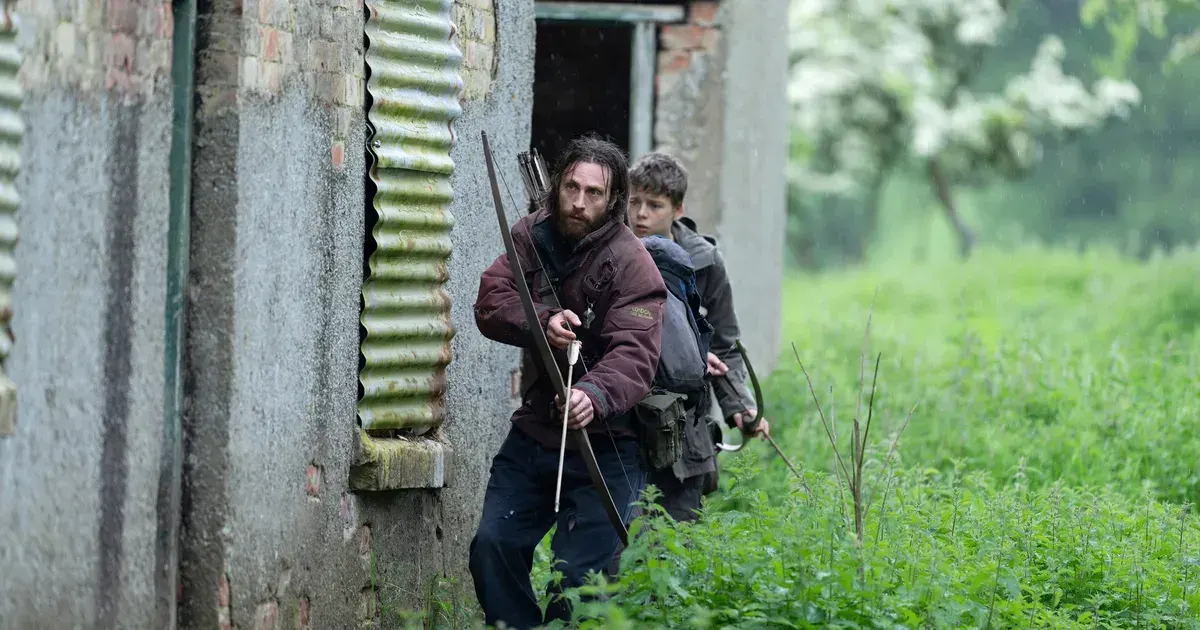
As for the action scenes, they’re artificial and generic. The most telling example takes place when a zombie sneaks up on Spike while he’s sleeping. Despite being ill, the mother suddenly wakes up and smashes the zombie against a table just before it can bite Spike. Let’s not forget that she’s supposed to be sick, so it’s highly unlikely that she’d have the strength to do something equivalent to what Jamie did with his arrows through the zombie’s skull. Plus, the fact that she wakes up right as the zombie is about to bite Spike creates the false impression that her illness is actually some kind of superpower. In reality, it’s just another scene designed to manufacture tension. This kind of scene is FAR too common throughout the film. Allow me to emphasize how SICK I am of this kind of practice in cinema and how much I hate it.
Then there’s the scene where a zombie gives birth and Spike and Isla silently decide to keep the baby. As Chuck McGill would say, “What a sick joke.” I couldn’t believe what I was watching! It’s absolutely ridiculous and comical to the point of being impossible to take seriously. Likewise, I find it REVOLTING, OUTRAGEOUS, and in POOR TASTE that the ritual in which Dr. Kelson kills Isla because she has cancer is portrayed as something emotional and liberating. Are you seriously telling me that killing a child’s mother because she has cancer is supposed to be moving and inspirational?
To top it all off, the cherry on this disaster of a cake is the ending—a dreadful showcase of how not to wrap up a mess like this. Within the span of 28 days after the mother’s death, we see Spike surviving alone in the wilderness like Bear Grylls. Can anyone explain how a defenseless child could suddenly develop such strong survival instincts? While he was with Dr. Kelson, the doctor warns that the baby needs milk soon; yet, somehow, the baby is safe and sound nearly a month later. To make matters worse, the baby winds up with a note written by Spike on the door of the island where his father and the group of survivors live, by some unexplained means.
Throughout the film, there are references to someone named Jimmy, who eventually appears at the very end accompanied by a group that looks like they came straight out of the Power Rangers. They show up completely out of nowhere for an abrupt and anticlimactic entrance, creating a cliffhanger that makes zero sense. 28 Years Later is steeped in a cloudy, lonely atmosphere, and these characters feel like a forced and edgy antithesis.
While the photography is visually appealing, the cinematography and camera work are incredibly clumsy at times. For instance, every time a zombie dies, the camera does an 180-degree spin like a video game kill-cam, which might seem flashy at first but quickly becomes a gimmicky and repetitive trick.
Much like El Camino: A Breaking Bad Movie, I think this film is completely superfluous and, in short, a total waste of time. I definitely won’t be the one following Spike’s story. In fact, I’ll probably forget about him sooner rather than later.